Artist portrait
“Artist portrait: Mikaël Monchicourt”, Point contemporain magazine, no. 22, September 2021, pp. 7-9.
Works mentioned: L'intérieur du liquide, Collection de lettres, Cup, Couturière, Système, JUKI, Tanneurs #1, PCB_9, Motifs for a Web revolution, Le bureau du statisticien, Wave
Where the reign of the word ends, something else begins.
Frank Herbert, in The Priests of Psi
Amalgamated, atomised or liquefied, the image is subjected by Mikaël Monchicourt to multiple interventions until it becomes “something else”. Starting from source material often drawn from Google Images, he ceaselessly questions the nature of what he will place on the steel or aluminium support and what will come to constitute the work. All the reflections he brings to bear on the image, he projects as much onto his own era as onto himself. Never imposing a political vision, or passing judgement on the concerns of society, he asks “how do I exist, and do I really exist?” in these times of mutation that our post-industrial societies are going through. From factory production lines to the oscillations of statistical curves, the images he works with raise the question of our own destiny and reveal other paths we might take.
From his very first works, Mikaël Monchicourt has sought to answer this question through the physical nature of letters, which give body to words and, by extension, to images. His Collection de lettres (2018), made of transfer letters on Plexiglas plates, forms an alphabet of simple figures in which the carbon characters break apart on contact with white glue, becoming so many dots which, once joined together, in turn constitute a new image.
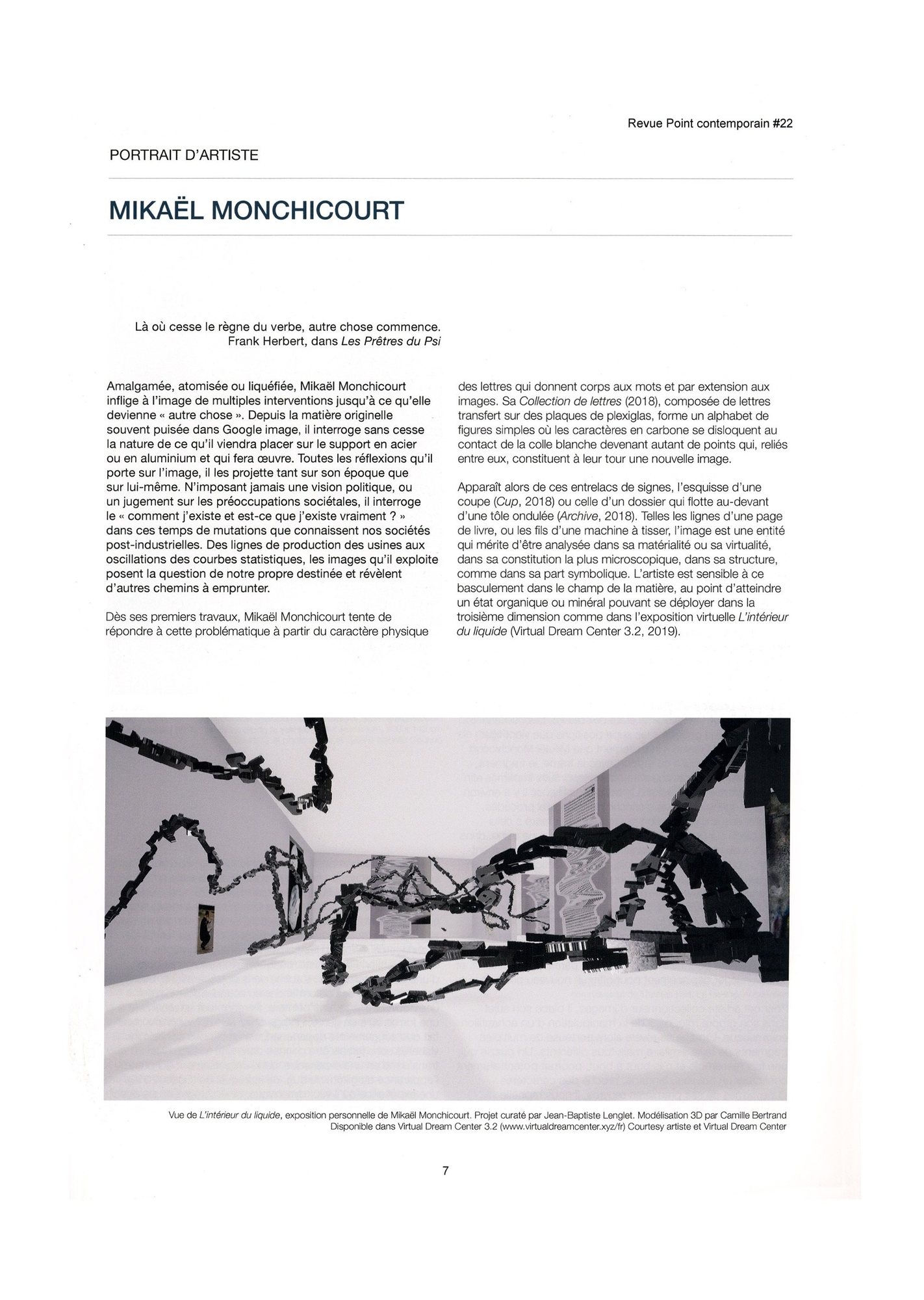
From these interlacings of signs there then emerges the outline of a cup (Cup, 2018), or that of a file floating in front of a sheet of corrugated iron (Archive, 2018). Like the lines on the page of a book, or the threads of a loom, the image is an entity that deserves to be analysed in its materiality or its virtuality, in its most microscopic make-up, in its structure as well as in its symbolic dimension. The artist is attuned to this tipping over into the realm of matter, to the point of reaching an organic or mineral state that can unfold into the third dimension, as in the virtual exhibition L'intérieur du liquide (Virtual Dream Center 3.2, 2019).
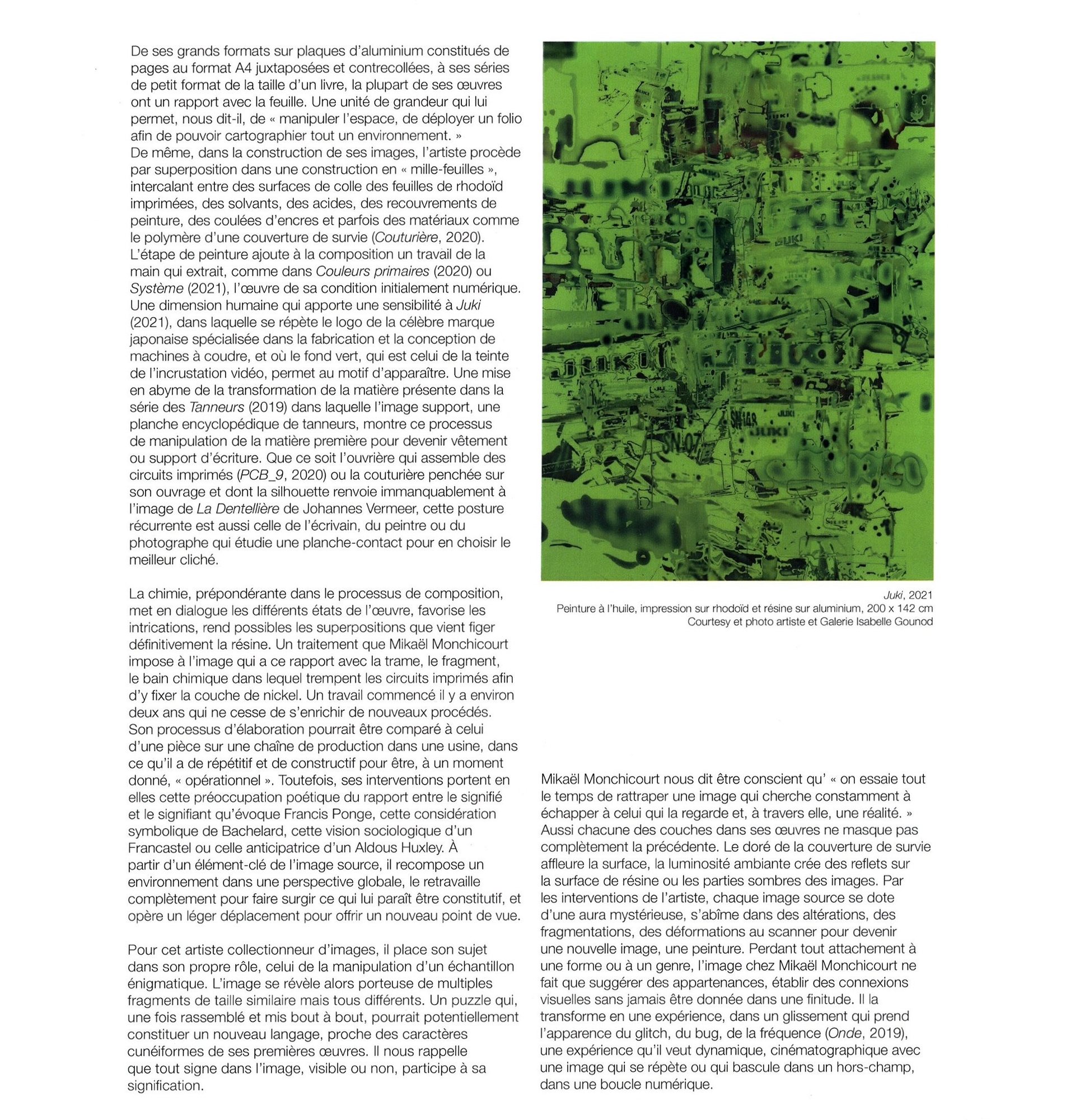
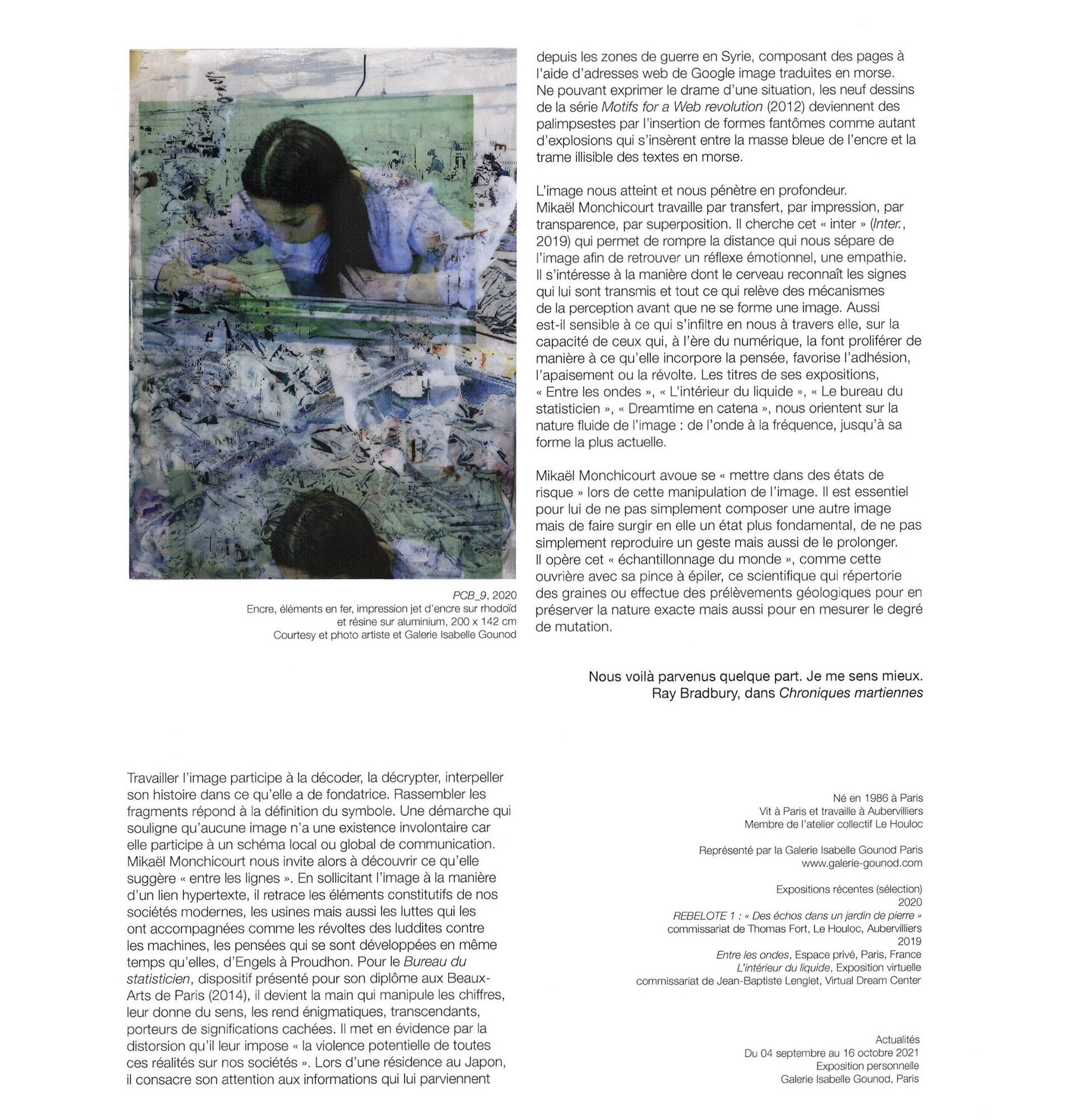
From his large formats on aluminium plates, made of juxtaposed and laminated A4 pages, to his small-format series the size of a book, most of his works bear some relation to the sheet of paper. It is a unit of measurement that allows him, he tells us, “to manipulate space, to unfold a folio so as to be able to map an entire environment.” Likewise, in building his images, the artist proceeds by superimposition, in a “mille-feuille” construction, interleaving between layers of glue printed sheets of Rhodoid, solvents, acids, coats of paint, runs of ink and sometimes materials such as the polymer of a space blanket (Couturière, 2020). The painting stage adds to the composition the work of the hand which, as in Couleurs primaires (2020) or Système (2021), draws the work out of its initially digital condition. This human dimension lends a sensitivity to Juki (2021), in which the logo of the famous Japanese brand specialising in the design and manufacture of sewing machines is repeated, and where the green background, the very shade used for chroma keying, allows the motif to appear. A mise en abyme of the transformation of matter runs through the Tanneurs series (2019), in which the support image, an encyclopaedic plate of tanners, shows the process by which raw material is worked until it becomes clothing or a surface for writing. Whether it is the woman worker assembling printed circuits (PCB_9, 2020) or the seamstress bent over her work, whose silhouette inevitably recalls The Lacemaker by Johannes Vermeer, this recurring posture is also that of the writer, the painter or the photographer studying a contact sheet to choose the best shot.
Chemistry, predominant in the process of composition, brings the different states of the work into dialogue, encourages entanglements, and makes possible the superimpositions that the resin then fixes for good. It is a treatment that Mikaël Monchicourt imposes on the image, one akin to the weave, the fragment, the chemical bath in which printed circuits are dipped to fix their layer of nickel. This is a body of work begun some two years ago, and it never ceases to be enriched by new processes. His working method might be compared to that of a part moving along a factory production line, in its repetitive and constructive character, until it becomes, at a given moment, “operational”. Yet his interventions carry within them that poetic concern for the relationship between signified and signifier evoked by Francis Ponge, that symbolic consideration of Bachelard, the sociological vision of a Francastel or the anticipatory one of an Aldous Huxley. Starting from a key element of the source image, he recomposes an environment from an overall perspective, reworks it completely to bring out what seems to him constitutive, and performs a slight shift to offer a new point of view.
This artist, himself a collector of images, places his subject in his own role: that of handling an enigmatic sample. The image then reveals itself as the bearer of multiple fragments, similar in size yet all different. A puzzle which, once assembled and laid end to end, could potentially constitute a new language, close to the cuneiform characters of his early works. He reminds us that every sign in the image, visible or not, contributes to its meaning.
Mikaël Monchicourt tells us he is aware that “we are forever trying to catch up with an image that constantly seeks to escape whoever is looking at it and, through it, a reality.” And so none of the layers in his works ever entirely conceals the one before. The gold of the space blanket rises to the surface; ambient light creates reflections on the resin or in the dark areas of the images. Through the artist's interventions, each source image acquires a mysterious aura, sinks into alterations, fragmentations and scanner distortions, to become a new image, a painting. Shedding all attachment to a form or a genre, the image in Mikaël Monchicourt's work merely suggests affiliations and establishes visual connections, without ever being offered as something finished. He turns it into an experience, through a slippage that takes on the appearance of the glitch, the bug, the frequency (Onde, 2019), an experience he wants to be dynamic and cinematic, with an image that repeats itself or tips over into the off-screen, into a digital loop.
To work on the image is to help decode it, decipher it, and question its history in what is foundational about it. Gathering the fragments together answers to the very definition of the symbol. Such an approach underlines that no image exists involuntarily, for every image takes part in a local or global scheme of communication. Mikaël Monchicourt thus invites us to discover what it suggests “between the lines”. By calling upon the image in the manner of a hypertext link, he retraces the constituent elements of our modern societies: the factories, but also the struggles that accompanied them, such as the Luddite revolts against machines, and the ideas that developed alongside them, from Engels to Proudhon. For the Bureau du statisticien, an installation presented for his diploma at the Beaux-Arts de Paris (2014), he becomes the hand that manipulates figures, gives them meaning, renders them enigmatic, transcendent, bearers of hidden significance. Through the distortion he imposes on them, he brings to light “the potential violence of all these realities on our societies”. During a residency in Japan, he turned his attention to the news reaching him from the war zones of Syria, composing pages out of Google Images web addresses translated into Morse code. Since the tragedy of such a situation cannot be expressed, the nine drawings of the series Motifs for a Web revolution (2012) become palimpsests through the insertion of ghostly forms, like so many explosions slipping in between the blue mass of the ink and the illegible weft of the texts in Morse.
The image reaches us and penetrates us deeply. Mikaël Monchicourt works through transfer, printing, transparency and superimposition. He seeks that “inter” (Inter., 2019) which makes it possible to break down the distance separating us from the image, so as to recover an emotional reflex, a form of empathy. He is interested in the way the brain recognises the signs transmitted to it, and in everything that belongs to the mechanisms of perception before an image takes shape. He is thus alert to what seeps into us through the image, and to the power of those who, in the digital age, make it proliferate so that it takes thought into itself and fosters adherence, appeasement or revolt. The titles of his exhibitions, “Entre les ondes”, “L'intérieur du liquide”, “Le bureau du statisticien”, “Dreamtime en catena”, point us towards the fluid nature of the image: from the wave to the frequency, and on to its most contemporary form.
Mikaël Monchicourt admits to “putting himself in states of risk” as he manipulates the image. For him it is essential not simply to compose another image but to bring forth within it a more fundamental state; not simply to reproduce a gesture but also to extend it. He carries out this “sampling of the world”, like the woman worker with her tweezers, or the scientist who catalogues seeds or takes geological samples in order to preserve their exact nature, but also to measure their degree of mutation.
Here we are, arrived somewhere at last. I feel better.
Ray Bradbury, in The Martian Chronicles
Original publication
Translated from the French. Read the original.